

If you are an MBA graduate or currently pursuing an MBA in Finance in India, you are already on the path to success. However, in today’s cutthroat job market, a degree is often just the entry ticket. To land “elite” roles at Big 4 firms (Deloitte, EY, KPMG, PwC) or global MNCs, you need a specialized edge.
This is where the ACCA (Association of Chartered Certified Accountants) comes in. By pairing your MBA with this globally recognized credential, you combine strategic leadership with high-level technical expertise.
ACCA recognizes the hard work you’ve already put into your MBA. Instead of making you “re-learn” what you already know, they allow you to skip certain papers. These are called exemptions. For a qualification that typically has 13 exams, getting a head start can mean the difference between qualifying in three years or finishing in just 12–18 months.
ACCA Exemptions for MBA Finance in India
For MBA graduates in India, the ACCA journey is split into two primary pathways. The Standard MBA Route typically offers 3 to 5 exemptions. In contrast, the ACCA-Accredited or Integrated MBA provides the maximum 9 exemptions, covering both the Knowledge and Skills levels entirely. This elite fast-track means you bypass all nine “F-series” papers and only need to clear the 4 Strategic Professional exams to become an ACCA Affiliate.
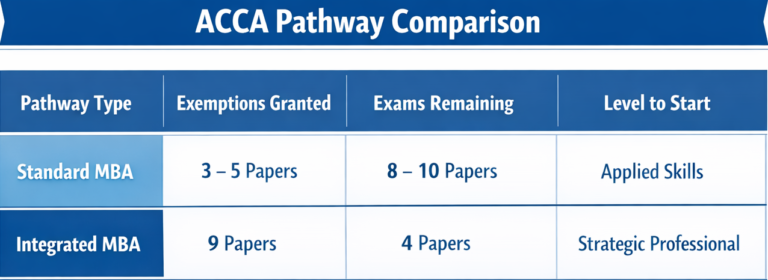
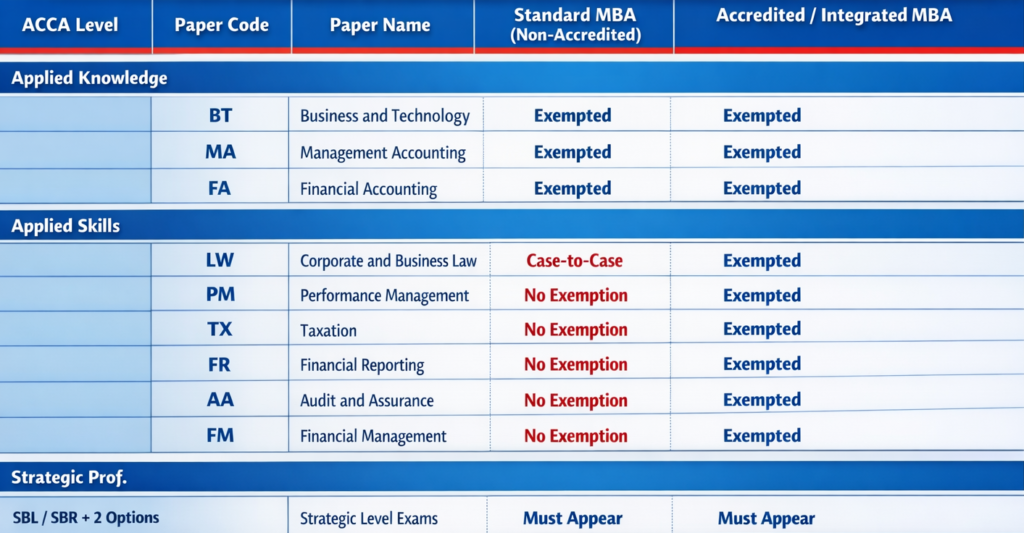
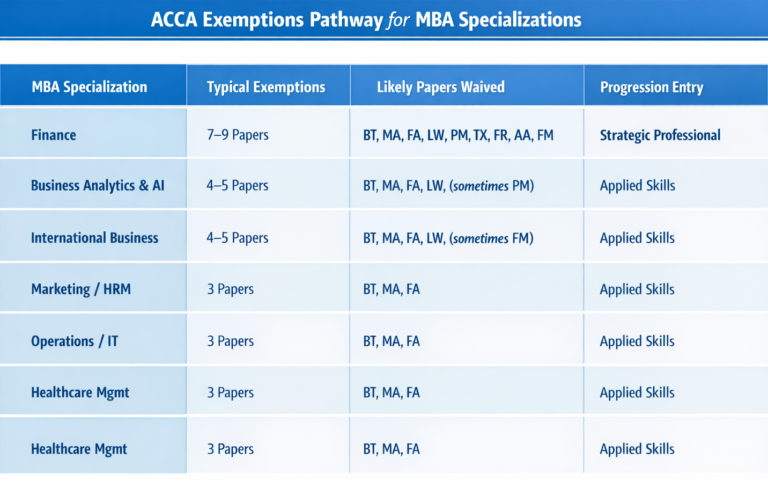
How MBA Streams Affect ACCA Exemptions
Professional Validation: MBA Finance vs. ACCA + MBA
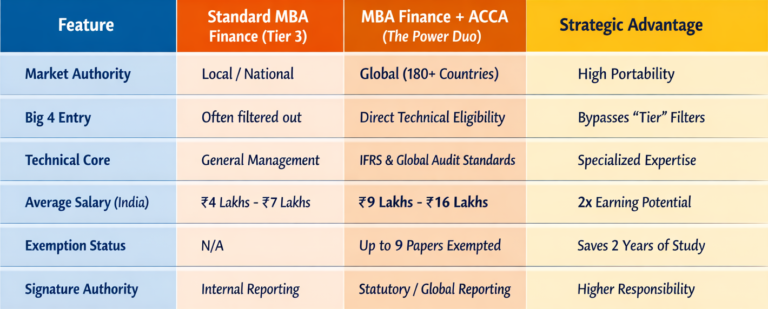
How Tier 3 MBA Finance Graduates Can Crack Big 4 Jobs with ACCA
For many Tier 3 MBA Finance graduates in India, breaking into Big 4 firms can be challenging due to college-tier filters, skill gaps in IFRS and global auditing, and limited industry exposure. However, adding a globally recognized qualification like the Association of Chartered Certified Accountants can completely change this trajectory.
ACCA helps students bypass tier-based limitations, gain expertise in international finance standards, and build a strong technical profile valued by top firms. With up to 9 exemptions for MBA graduates, students can fast-track their ACCA journey and focus on strategic-level skills required by Big 4 and MNCs.
With the right guidance from SISF Education, students can maximize exemptions, develop practical finance knowledge, and create a Big 4-ready career path.
Why Pursue ACCA After MBA in Finance & Who Should Consider It?
If you are wondering whether pursuing ACCA after an MBA is worth it, the answer lies in the powerful combination of management knowledge + global financial expertise. In India, MBA + ACCA is considered a highly valuable career combination, especially for students aiming for global finance roles.
One of the biggest advantages is global recognition. While an MBA provides strong business fundamentals, the Association of Chartered Certified Accountants qualification is recognized in over 180 countries, opening doors to international career opportunities. Additionally, top firms like Deloitte, EY, KPMG, and PwC actively prefer candidates who understand both strategic management (MBA) and technical standards like IFRS and global auditing (ACCA).
Another key benefit is higher salary potential, with MBA + ACCA professionals in India earning between ₹8–15 LPA or more, depending on skills and experience. Moreover, students can benefit from ACCA exemptions for MBA and MBA Finance in India, allowing them to skip multiple exams and complete the qualification faster.
ACCA is ideal for MBA graduates who want careers in:
- Accounting and auditing
- Corporate finance
- Investment banking
- Risk management
- Global finance roles
Students with specializations in finance, accounting, or business analytics benefit the most. By combining MBA with ACCA, professionals gain a strong competitive edge, making it easier to secure roles in Big 4 firms and multinational companies.
Key Benefits of ACCA for MBA Graduates
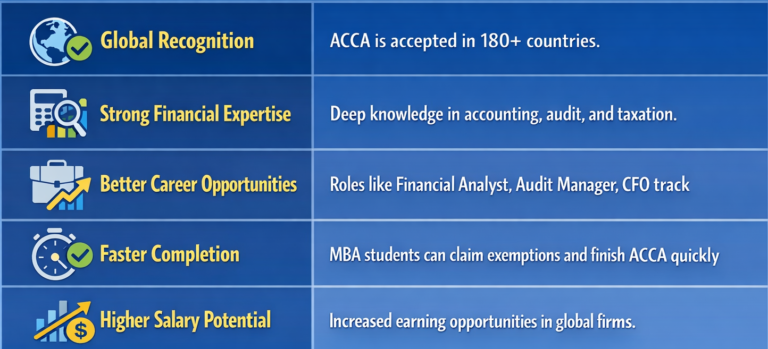
Pursuing ACCA after an MBA offers significant advantages, including global recognition, strong technical expertise in accounting and finance, and better career opportunities. ACCA complements MBA knowledge by providing in-depth skills in audit, taxation, and financial reporting, helping graduates access high paying roles and international career growth.
Combining an MBA with ACCA creates a powerful career profile. Some major advantages include:
How to Claim Your MBA Exemptions for ACCA
Don’t guess which papers you can skip. Follow these steps to get an official confirmation:
- Use the Exemption Calculator: Visit the official ACCA Global Exemption Calculator and enter your university name.
- Register as a Student: You must create an account on the ACCA portal.
- Upload Documents: You will need your official MBA transcripts and degree certificate (stamped and signed).
- Pay the Exemption Fee: Note that while you don’t sit for the exam, ACCA charges a one-time fee for each exempted paper to “claim” the credit. If you are looking for the best ACCA coaching in Indore, SISF Education offers expert faculty, structured training, and strategic exam preparation to help students complete ACCA faster and achieve global career opportunities.

Conclusion
Pursuing ACCA after an MBA in India is a smart way to fast-track a global finance career. With ACCA exemptions for MBA and MBA Finance, students can skip multiple papers, save time, and focus on advanced skills required by top companies.
The MBA + ACCA combination creates a strong profile valued by Big 4 firms, MNCs, and global finance roles, offering expertise in IFRS, accounting, and strategic finance. For the right guidance, SISF Education helps MBA graduates maximize exemptions, prepare effectively, and achieve faster career growth. SISF Education specializes in ACCA exemptions for MBA and MBA Finance in India, helping students maximize exemptions and reduce the total number of exams. With a practical, results-driven approach, SISF builds strong concepts required for careers in accounting, finance, and auditing.
Frequently Asked Questions:
Can MBA graduates get exemptions in ACCA?
Yes, MBA graduates can receive ACCA exemptions if their academic subjects match the ACCA syllabus. Depending on the specialization and university curriculum, MBA graduates may receive exemptions from some papers in the Applied Knowledge and Applied Skills levels.
How many ACCA exemptions are available for MBA Finance in India?
Students with an MBA in Finance may receive up to 4–6 exemptions, and in some accredited programs even more. The exact number depends on the subjects studied, such as accounting, financial management, taxation, and auditing.
Is there MBA exemption for ACCA in India?
Yes. ACCA provides exemptions for MBA graduates in India after reviewing their academic transcripts and syllabus. If the MBA program covers similar topics to ACCA subjects, students may skip certain exams.
Can MBA Finance students get more ACCA exemptions than a regular MBA?
Generally, yes. MBA Finance students usually receive more exemptions because their program includes finance and accounting-related subjects that closely match the ACCA syllabus.
Do MBA graduates still need to complete ACCA exams?
Yes. Even if MBA students receive exemptions, they still need to complete the remaining ACCA exams, especially the Strategic Professional level, to become fully qualified.
Is ACCA worth pursuing after an MBA?
Yes, ACCA can significantly enhance career prospects after an MBA. It provides deep expertise in accounting, audit, taxation, and financial reporting, which complements the management knowledge gained in an MBA program.
Is there a time limit to complete ACCA after an MBA?
Yes, the 7-year rule applies in 2026. Once you pass your first Strategic Professional exam, you have seven years to complete the remaining professional papers. However, there is no time limit for completing the Applied Knowledge or Skills levels.